

Date/Time:
This event takes place December 4–6
(Asia-Pacific restream December 5–7), 2026.
View in your local time

Registration
Registration will close 1 hour in advance of the event. Full refunds will be given for cancellation requests up to 1 hour in advance of the event.

Who can attend this event?
This program is open to everyone.

Translation
Live interpretation will be provided during the teachings in Chinese, French, German, Japanese, Portuguese, Russian, and Spanish. Recordings of these sessions will also be available in these languages.
イベントに登録するには?
(For Japanese students only)
The teachings on the six bardos point out the fundamental continuity of mind through all states of existence. From this perspective, what we call “life” and “death” are simply concepts — relative designations that are attributed to a continuous state of being, an indestructible awareness that is birthless and deathless.
— Dzogchen Ponlop Rinpoche
In the Vajrayana Buddhist tradition, the word bardo is often associated with the transition between death and rebirth. However, bardo is much more than a destination — it is a continuous experience of the present moment. From the perspective of the “six bardos,” every transition in our lives, from the gap between two thoughts to the shift between waking and sleeping, offers a fresh opportunity to recognize the nature of our mind.
In this special, collaborative event between Tergar International and Tergar Institute, streamed live from Tergar Osel Ling Monastery in Kathmandu, Mingyur Rinpoche, Tergar Khenpos, and a range of international faculty members will guide us through an experiential exploration of the six bardos.
Drawing on the essential instructions of the lineage and presented in diverse learning formats, including seminar-style sessions, specialized breakout groups, in-depth group meditation practices, and community-strengthening activities, this program will help us connect with various approaches for transforming the uncertainty of transition into the path of awakening.
Whether we are facing major life changes or simply navigating the moment-to-moment bardos of everyday life, these teachings provide a map for staying present, compassionate, and awake in the face of groundlessness. This retreat is an invitation to move beyond the fear of change and discover the luminous, unchanging awareness that is our true home.
This event will be streamed live from Tergar Osel Ling in Kathmandu. To attend the event in person, please follow the link HERE for more information and booking.

Can I get access to a recording of this event?
Recordings will remain accessible for two months and can be accessed anytime by logging in to the event page. However, these recordings are intended solely for review after watching the teachings live. Rinpoche has specifically requested live attendance for this event because these profound and important teachings are most beneficial when received in real time.
Please note that participants in some regions may encounter difficulties accessing the recordings due to local restrictions.
WHY SHOULD I ATTEND?
We often spend our lives trying to build solid ground under our feet, yet the reality of our situation is one of constant flux. These experiential and applied teachings on the six bardos offer a rare opportunity to shift our perspective. Instead of fearing life’s transitions, we learn to inhabit them as sacred moments of profound potential to discover our true nature.
WHAT WILL I LEARN?
In this program, you will learn about:
- the meaning and significance of the six bardos
- the historical context for the bardos within our lineage
- creative techniques to work skillfully with life’s transitions, transforming fear and uncertainty into opportunities for growth and renewal
WHAT IS INCLUDED IN THIS PROGRAM?
- Live teachings, Q&A, and practice sessions with Mingyur Rinpoche
- Teaching sessions with Tergar lamas, Tergar Institute faculty, and Tergar International guides
- Interactive seminar-style sessions led by international faculty
- Specialized break-out sessions aimed at exploring how the bardos can be applied in diverse settings
- Group meditation sessions
REQUIREMENTS FOR PARTICIPATION:
This program is open to everyone.
Special note for students in Asia-Pacific time zones
For students in the Asia-Pacific time zones, Mingyur Rinpoche’s teachings will now be restreamed at convenient morning/afternoon times on Dec 5–7. Live simultaneous interpretation in Chinese and Japanese is planned for the restream, and other languages may be added closer to the event.
Simultaneous interpretation
Live interpretation will be provided during the teachings and Q&A in Chinese, French, German, Portuguese, Russian, and Spanish. Recordings of these sessions will also be available in these languages.
About "Finding Freedom in Life’s Transitions:
Teachings on the Six Bardos"
Turn on subtitles using the CC icon in the upper right corner.
Then click Settings and select your preferred language.
Get Your Online Tickets!
Pick the choice that best suits you
Register to be a member of the Tergar Community. If you are already a member, log in.
You will receive a confirmation email.
Enjoy the experience
Online
Reduced
$100 00 USD
We warmly invite you to choose this fee if you’re experiencing financial hardship. A limited number of reduced-fee tickets are available for each event to help make participation possible for those who might not otherwise be able to join.
Full refunds will be issued for cancellation requests made at least one hour before the event.
Tergar is a nonprofit organization committed to making the benefits of meditation available to all. If the fees prevent you from participating,
click here
to request a discount.

1
REQUEST DISCOUNT

2
RECEIVE YOUR COUPON CODE

Do you need more financial assistance?
We understand that finances can be challenging, so we’d like to offer you additional financial assistance to help you participate in the event.
Please choose the discount rate below that best suits your circumstances. If you need a larger discount than those listed below, please contact us at [email protected]
Country / Region *
Select your preferred discount rate *
Your coupon code:

Discount details:
- This coupon is valid for one-time use only and is non-transferable.
- It will remain valid until
Next steps:
1. Copy your coupon code by clicking on the copy icon or write it down. You will also receive it via email.
2. You will be redirected to the event registration page.
3. Be sure to select the "Reduced Fee" price box, as the coupon code is not valid for the base fee or sponsor fee.
4. If the event has prerequisites, you will need to complete a form.
5. Once you submit the form, a checkout window will appear.
6. Click on “Apply Coupon” located below the event name and paste your coupon code there
Schedule
Local time
If you are interested in attending this event in person, please click on this link.
About Mingyur Rinpoche
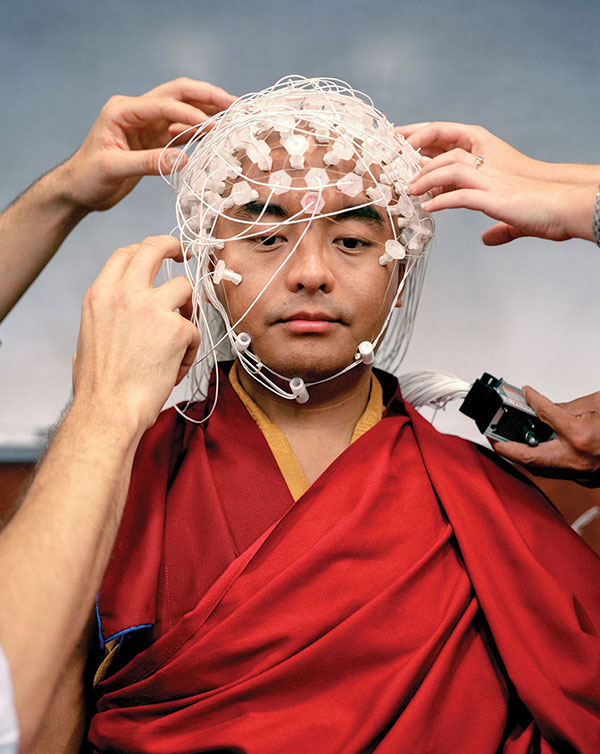
In his approach to teaching meditation, Mingyur Rinpoche integrates traditional Buddhist practice and philosophy with the current scientific understanding of the mind and mental health – making the practice of meditation relevant and accessible to students around the world.
Mingyur Rinpoche is a world-renowned meditation teacher with personal experience of anxiety and panic attacks, which he suffered from throughout his childhood and into his teenage years, when he learned to transform his panic through meditation. Born in Nepal in 1975, Mingyur Rinpoche began to study meditation as a young boy with his father, Tulku Urgyen Rinpoche, himself a well-respected Buddhist teacher. As a child he became interested in contemporary science through conversations with scientists who were visiting his father, and as he grew older he began to collaborate with neuroscientists and psychologists, including Richard Davidson and Antoine Lutz at the University of Wisconsin, on research projects that study the effects of meditation on the brain and the mind.
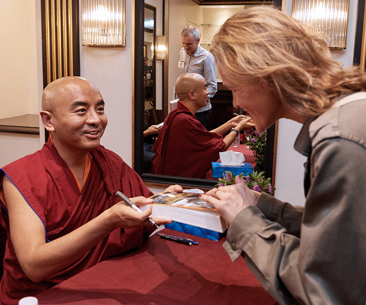
Mingyur Rinpoche’s first book, The Joy of Living: Unlocking the Secret and Science of Happiness, debuted on the New York Times bestseller list and has been translated into over twenty languages. His second book, Joyful Wisdom: Embracing Change and Finding Freedom, explores how difficult emotions and challenging life situations can be used as stepping stones to discover joy and freedom. In his most recent book, In Love with the World, Mingyur Rinpoche shares how his meditation practice sustained him when he left his monastery to wander through India and the powerfully transformative insights he gained from the near-death experience he had at the beginning of his journey. Mingyur Rinpoche recently appeared in the Netflix series The Mind, Explained, in an episode about the benefits of mindfulness.
As the head of the Tergar Meditation Community, Mingyur Rinpoche supports groups of students in more than thirty countries, leading workshops around the world for new and returning students every year.
About Khenpo Kunga
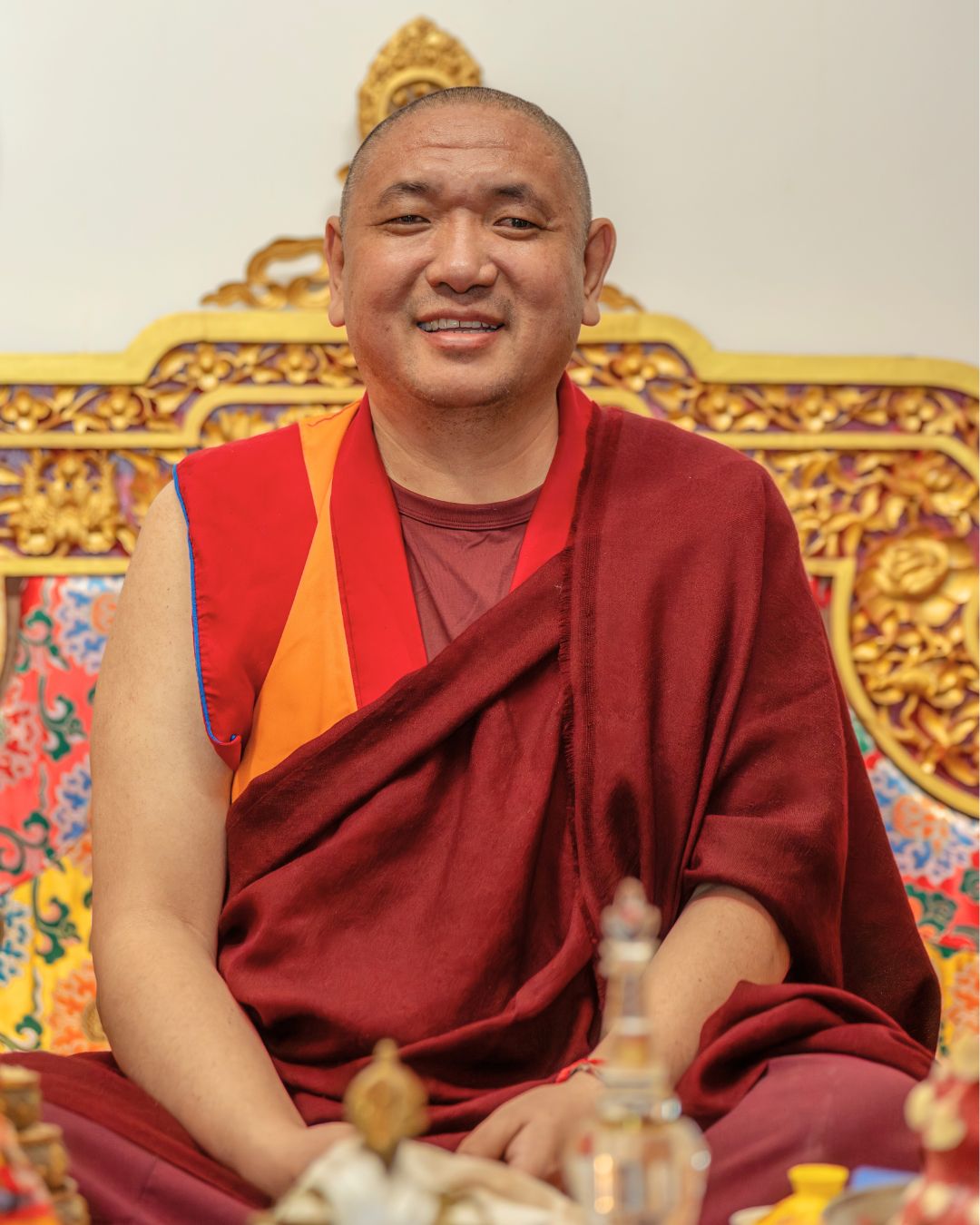
Khenpo Kunga is a Senior Tergar Lama. He became a monk at a young age and began his education at Tergar monastery, where he studied the rituals, prayers, and other traditional practices of the Tibetan Buddhist tradition. At fifteen, he entered an extended meditation retreat and spent three years mastering the profound contemplative practices of the Kagyü lineage.
Following this period of intense meditation practice, he entered the renowned Dzongsar monastic college near Dharamsala in Northwest India. After studying there for eleven years and receiving his Khenpo degree (roughly equivalent to a PhD), he taught at Dzongsar college for three additional years. Khenpo Kunga’s primary teacher is Yongey Mingyur Rinpoche, though he has studied with many other revered masters as well.
In recent years, Khenpo Kunga has taught in Asia, Europe, and the United States as one of the main teachers for the worldwide network of Tergar monasteries, meditation centers, and meditation groups. Most recently, he completed a three-year solitary retreat at Tergar Osel Ling monastery in Kathmandu, Nepal, further deepening his commitment to realization for the benefit of all beings.
About Khenpo Gyurme Wangchen
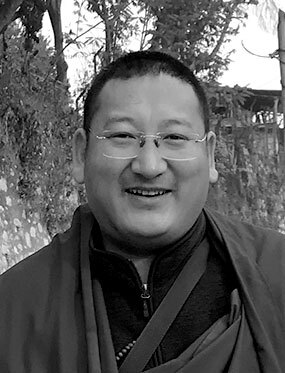
Khenpo Gyurmé ordained as a monk at Tergar Monastery, Nepal, at the age of six. There he completed the primary monastic education, studying Tibetan language, Buddhist ritual, and philosophy. Following his training at Tergar Monastery, he was sent to Sherabling Monastery, the seat of Tai Situ Rinpoche, to complete nine years of formal Tibetan Buddhist College (shedra). After graduating from the shedra, he taught for three years and eventually was granted the title of Khenpo, a recognition of his scholarly accomplishment and contribution to monastic education. Khenpo Gyurmé has also studied meditation extensively with Tai Situ Rinpoche and Yongey Mingyur Rinpoche.
Khenpo Gyurmé is continuing his practice as the Principal of Education at Osel Ling Monastery in Nepal and has been teaching there for the past thirteen years. He is responsible for coordinating and overseeing more than 180 young monks' studies and teaching monastic and lay students, thus playing a very significant role in the development of the monastery. As the Abbot of the monastery, he is devoted to educational development and to supporting Buddhist practitioners along their path.
Upgrade and Join the Full Year-Long Transmission
Confirm to proceed and update your membership for access to all retreats and courses in this transmission.
Before proceeding to Upgrade, please read and acknowledge the following:
Confirm Cancellation Before Upgrading
To upgrade to the full transmission plan, you’ll first need to cancel your current Vajrayana Online membership. Once canceled, you can immediately select a new plan here to complete the process.
Are you ready to proceed?


